Payday banned
Borrowing in Maine: What State Law Allows
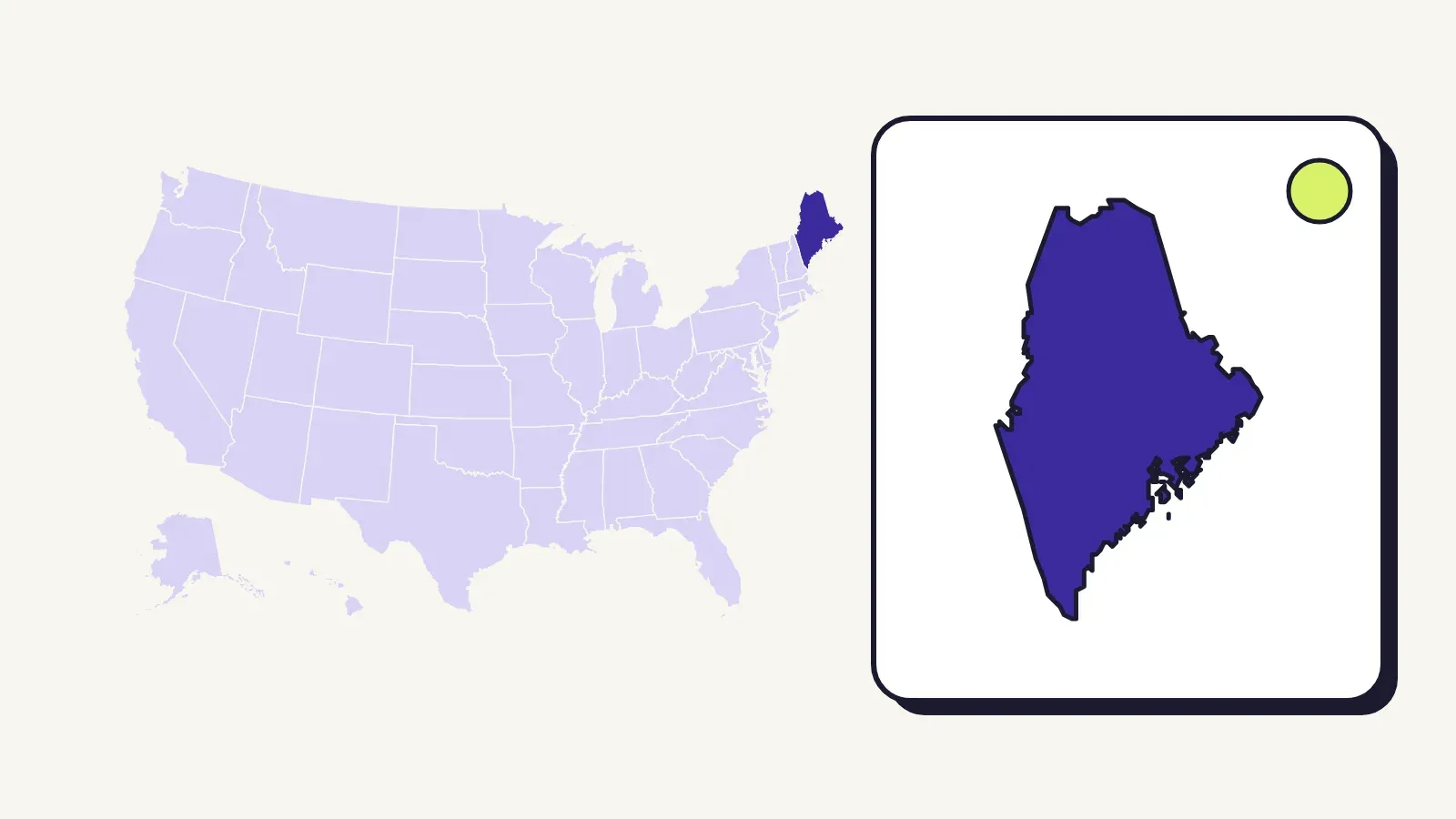
Maine's rate limits for non-bank lenders are low enough that storefront payday and title lenders don't fit under them. Here is what licensed lenders may charge and how Maine protects you from old debts.
By Lendmira Editorial Team Updated 6 min read
- Payday loans
- Not available
- Small loan rate cap
- 30% a year up to $2,000
- Time to sue on debt
- 6 years
- Wages protected
- At least 75% of pay
The short version
Maine limits loans from licensed non-bank lenders to 30% a year on the first $2,000, 24% on the next $2,000 and 18% above that. Check cashers may not cash postdated checks or hold a check for later deposit, so storefront payday loans aren't available, and car title loans face the same rate limits. A creditor has six years to sue, collectors can't sue more than six years after your last activity on a debt, and a later payment doesn't restart that clock.
Maine lending rules at a glance
Why payday lenders don't operate in Maine
Maine doesn't have a payday lending law. Instead, two rules close off the business model. First, the check cashing law, 32 M.R.S. section 6138, says a check casher may not cash or advance money on a postdated check, agree to hold a check for later deposit, or issue a check without receiving the full amount in cash. That is how a payday loan works, so check cashers can't offer one.
Second, non-bank consumer lenders are licensed by the Bureau of Consumer Credit Protection as supervised lenders and must stay within the Maine Consumer Credit Code's rate limits. Those ceilings leave no room for a fee of $15 or more per $100 every two weeks.
What licensed lenders may charge
Title 9-A, section 2-401 sets the finance charge limits for consumer loans other than open-end credit:
| Part of the unpaid balance | Maximum yearly rate |
|---|---|
| Up to $2,000 | 30% |
| $2,000.01 to $4,000 | 24% |
| Over $4,000 | 18% |
| Whole loan, when more than $8,000 is financed | 18% |
For very small loans, a lender may charge a flat minimum instead: $5 if you borrow $75 or less, $15 if you borrow more than $75 but less than $250, and $25 for $250 or more. On a short loan those minimums can push the APR well above 30%, so ask for the APR and the dollar cost before you sign.
Maine has no law authorizing car title loans at higher rates, so a loan secured by your car from a supervised lender stays under the same limits. Compare offers with the loan payment calculator.
Maine's limits on old debt
The general rule, 14 M.R.S. section 752, gives a creditor six years after a claim arises to sue. That rule covers most consumer debts, including credit card debt.
Maine's Fair Debt Collection Practices Act adds two protections that many states lack:
- A debt collector may not file a collection lawsuit more than six years after your last activity on the debt, or sooner if a shorter limit applies.
- A later payment, a written or spoken promise to pay, or other activity on the debt does not revive or extend that period.
- A collector may not sue when it knows, or should know, that the time limit has run.
So a small good-faith payment on a very old debt won't reopen the door to a lawsuit, as it can in some states. For more, see old debt and the statute of limitations.
How much of your paycheck is protected
Maine protects more of your pay than federal law does. Under 14 M.R.S. section 3126-A, a creditor with a judgment can take no more than the least of three amounts each week:
- 25% of your disposable earnings plus exempt income;
- the amount by which that total exceeds 40 times the federal or Maine minimum hourly wage, whichever is higher (federal law uses 30 times the federal minimum);
- your total disposable earnings.
The higher multiplier and the use of Maine's own minimum wage mean that a lower-income worker may have no wages garnished at all.
Filing a complaint in Maine
- Look up the business on the Bureau of Consumer Credit Protection's licensee search or NMLS Consumer Access. Lenders, loan brokers and debt collectors all need a Maine license.
- Gather your papers: the loan agreement, payment records and any letters or texts from the lender or collector.
- File a complaint with the Bureau online. If a collector sues you over a credit card or student loan, the Bureau also offers a court answer form you can use.
Common questions
Are payday loans legal in Maine?
Storefront payday loans aren't available. Check cashers can't hold postdated checks, and licensed lenders are limited to 30% a year on the first $2,000, plus small minimum charges on tiny loans.
Are title loans legal in Maine?
No law authorizes high-cost title loans. A loan secured by your car from a licensed lender must stay within the same rate limits as other consumer loans.
What is the statute of limitations on debt in Maine?
Six years for most debts, including credit cards. Collectors can't sue more than six years after your last activity on the debt, and a later payment doesn't restart the clock.
How much of my wages can be garnished in Maine?
No more than 25% of your weekly disposable earnings, and nothing from the amount up to 40 times the higher of the federal or Maine minimum wage.
Sources
- Maine Bureau of Consumer Credit Protection
- 9-A M.R.S. section 2-401 — Finance charges on consumer loans
- 32 M.R.S. section 6138 — Check casher limitations
- 14 M.R.S. section 752 — Six-year limitation
- 32 M.R.S. section 11013 — Prohibited collection practices, time-barred debt
- 14 M.R.S. section 3126-A — Limits on earnings withholding
Facts on this page were checked against these sources on October 13, 2026. Maine's garnishment protection is tied to the minimum wage, so the protected dollar amount changes when the wage does.
Keep reading
-

Debt help
Old debt and time limits
Most states give collectors 3–6 years to sue. What can restart the clock, and why it's not the 7-year credit rule.
-
Loan type
Payday loan alternatives
Credit union PALs up to $2,000 at 28% APR or less, paycheck advances, payment plans and local help.
-
State law
New Hampshire
Payday and small loans capped at 36% APR, but title loans may charge 25% a month; 3-year limit on debt suits.